Your Task List Is Not Long. Your Task List Is Undecided
Why capturing everything stopped working, and what actually settles an overloaded mind.

Count how many times you have started over.
New app, clean notebook, fresh page, better system. You moved everything across on a Sunday evening and felt honestly calm for about four days.
Then the same weight came back wearing slightly different colours, and you went looking for the next system. Almost everyone with a heavy list has done this, and almost nobody says so out loud.
Rebuilding the container feels like progress, and it costs you nothing at all.
Deciding costs you something every single time, which explains why you keep choosing the rebuild.
What stings is how ordinary the real cause turns out to be.
Most of the weight you carry comes from choices you postponed, and some part of you keeps checking on every one of them, all day long, without ever asking your permission.
You are behind on your answers, and running short of answers feels exactly like running short of time.
Unfinished Work Does Not Need Finishing. Unfinished Work Needs Deciding.
Psychologists have a name for the reason an unfinished job keeps talking to you. Bluma Zeigarnik noticed in the 1920s that people hold on to interrupted work far better than work they completed. Waiters carried complex orders perfectly until the bill got settled, and then the whole order vanished from memory within seconds.
Her name now sits on a simple claim. Unfinished work stays awake inside you, while finished work goes to sleep.
Look at your list with that idea in mind. Every line on it is a waiter standing at your table, holding an order you never confirmed, waiting for you to nod.
I want to be fair about the science here, since Zeigarnik’s original result has proven hard to reproduce cleanly and psychology has been rightly humbled over the past decade.
However, a much sturdier finding sits right beside it.
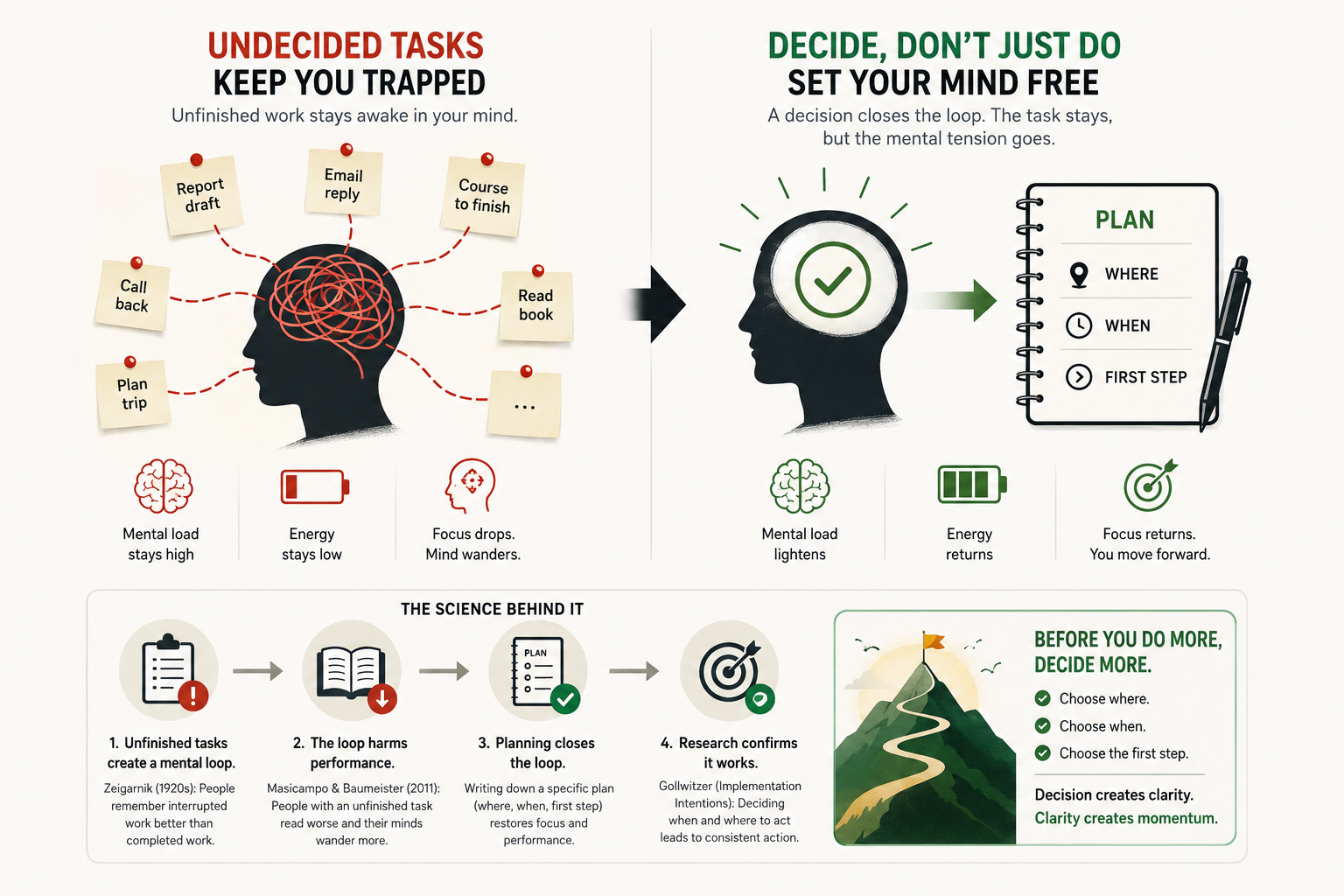
In 2011, two researchers named E.J. Masicampo and Roy Baumeister asked students to name an important task they had not done yet. Then everyone read the opening pages of a novel, and the researchers tested how well each person had followed the story.
Students carrying an unfinished task read worse. Their comprehension dropped, and their minds wandered more often.
Then came the interesting part. A second group wrote a specific plan for that unfinished task before reading. Where they would do it, when they would start, and what the first move would be. Their reading scores came back to normal.
Nothing had been crossed off. The task sat exactly where it was. Writing the plan alone was enough to let the mind put the loop down.
Your mind is not asking you to work harder. Your mind is asking you to answer.
That planning result also sits inside a much wider body of work. Peter Gollwitzer spent his career studying what he calls implementation intentions, which is a plain idea wearing a formal name. You choose in advance when and where you will act. A review of 94 studies found the effect to be large and consistent across health habits, study habits, and work.
So the fix for a heavy list starts somewhere unexpected. Before you try to do more, try to decide more.