
Two Horses
An argument against authoritative people’s assumptions for today’s AI era.

I can lay out this argument simply by stating what I want to say.
However, it would not be that effective, and perhaps you would not be moved by it. In order to make an impact, I believe you need to make sure the reader flows with the idea and what it offers.
And to do that, nothing is better than a metaphor or a story.
This one, in particular, is not like the ones I am used to publishing here. Instead, it is a gateway to the idea’s core in its simplest form.
I am simply using an example to help you understand how the assumptions you find on the internet, about something that has always been critical for our growth, are wrong, or simply put, not well-constructed. Without it, we might still be struggling with the little things.
Their structure, from the outside, looks astonishing, but inside, it is all hollow.
Something that will crack if only struck with your index finger, just like you would hit a carrom striker.
Yet, I want to acknowledge that it is a simple thought but not an easy one: to question the authoritative people on the internet, so that we can progress towards a better future, even by 1%, without unleashing chaos in the world or in ourselves.
Now, let’s begin with the story. I hope you like it.
The Opportunity
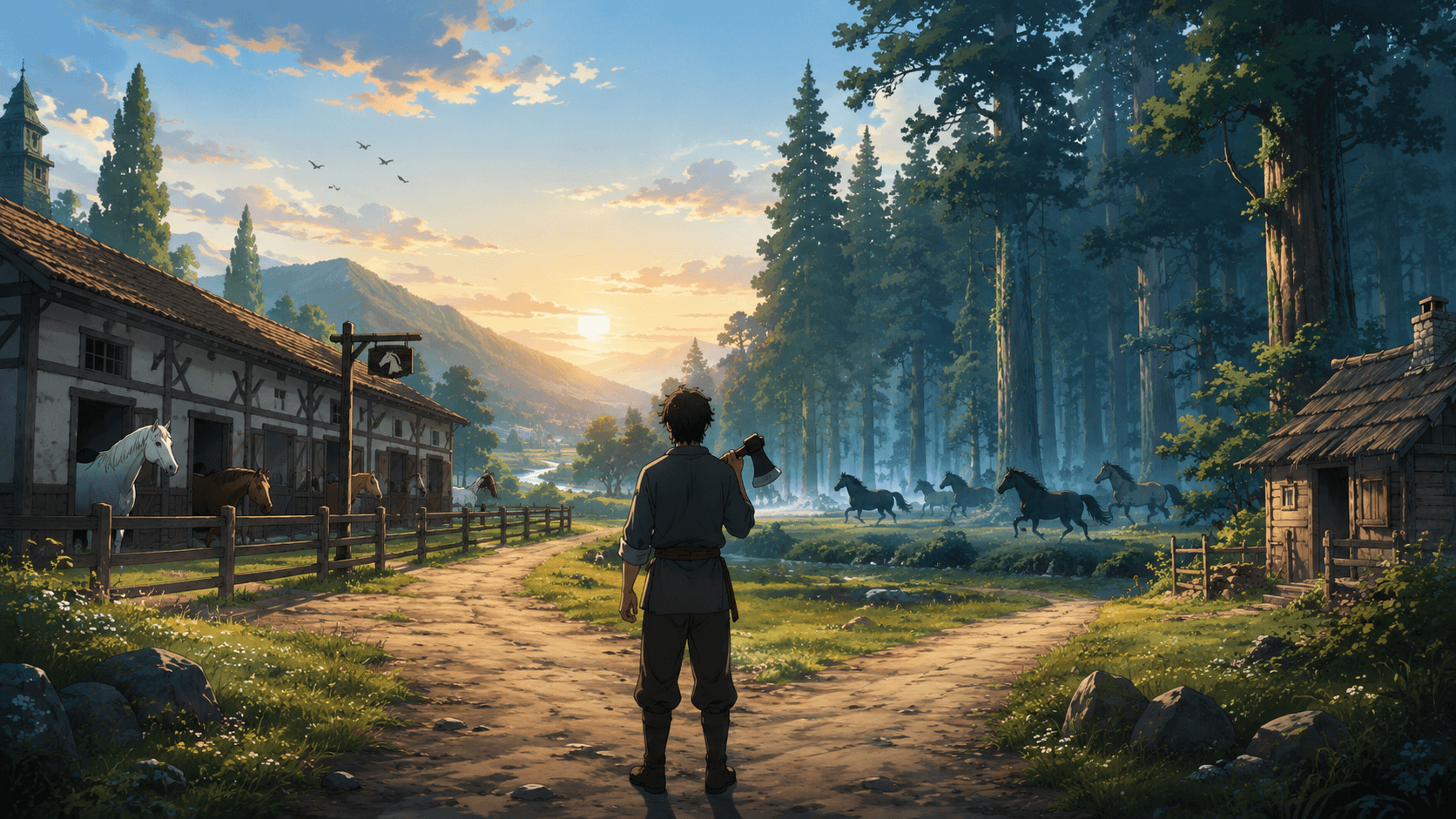
On a lavish land, not so far away, there was a stable. It used to be home to hundreds of well-trained horses. They were well maintained: fed on time, cleaned on time, and put out in the field on time for rehearsal, training, and a little warm-up to help them feel like themselves.
At a little distance from this stable, there was a forest, deep and full of gigantic trees. This forest was also home to many creatures, and among them were horses, too.
On the other side of the stable, there was a small house belonging to a wood chopper.
The wood chopper was a man of keen observation, with a love for his work and the determination to go beyond his limits. Every day, he would commute to the deep forest to spot the best trees for wood and cut them down, both for his home and for some of his customers.
During his commute to the forest, he would see the stable’s horses and think about getting one for himself someday, since carrying wood on his back and pulling the cart were not easy tasks.
However, this thought was challenged every time he saw the horses of the forest.
Because they were in the forest on their own, with all the freedom, rather than buying one, he thought of catching one of those instead.
A couple of times, he tried to go near them, but they were wild horses: big, carefree. Every time he took his steps forward, they spotted his intentions from far away and ran off, nowhere to be found.
Thus, disappointment became part of his routine, too.
But he never lost the hope of getting a horse in his life and fulfilling his dream of riding across the land.
And because his dream was pure, the universe decided to test his willingness to go after his ambition. So, on a fine morning, a merchant from another state arrived at his doorstep.
The knock was loud enough to spring our wood chopper out of his bed. He hurried to the gate and found the merchant waiting with a big smile.
“Hello there, Mr…” said the merchant.
“Mr. Whitwick,” replied the wood chopper.
“Yes, Mr. Whitwick. I’m Joseph from upstate. I have some business to discuss.”
“Upstate? I’ve updated my ledgers just last week.”
“Ha ha. No, no, Mr. Whitwick, I’m not from the tax collections department,” said the merchant. “I have some other business to discuss, an opportunity, of sorts.”
“Thank the lord! I was worried. Oof,” replied Mr. Whitwick. “Please come, have a seat. I’ll fetch something for you to drink.”
“Don’t trouble yourself, Mr. Whitwick. I’m fine, and I’m in a bit of a hurry, too. Would you mind if I just discussed the opportunity, real quick?”
“Oh, sure. If you don’t mind, I don’t mind.”
“Great! I’ll be real quick.”
And so, the merchant laid out the opportunity in front of our wood chopper. He explained that in his city, they were building a bridge, and for that, they would need a great deal of wood, around 50 tons. Having heard about him, he would like the wood chopper to deliver the requirements within two months.
At first, the wood chopper wondered whether he could deliver the material on time, but then he looked out of his window and saw the big, lavish trees dancing with the wind in the jungle.
“Okay, I can fulfil it,” said the wood chopper.
“Well, that’s great news,” replied the merchant. “And as a token of our deal, here’s the advance payment.” He laid out a big bundle of notes on the wood chopper’s dining table.
“I appreciate that.”
“No need, no need,” said the merchant, giving the wood chopper a pat on the shoulder. “I shall see you in two months with all the wood we need for the bridge, right?”
“Yes, yes, you worry not. I’ll bring it fast and good.”
“Great! All right then, Mr. Whitwick, it’s been a pleasure doing business with you.”
“Same here, Mr. Joseph,” replied Mr. Whitwick.
And with that, the merchant took his leave, and the wood chopper was left alone in the house with his thoughts.

This One or That One?
From that day onwards, the wood chopper began his work.
He would rise early and run towards the jungle to cut the trees. For six weeks, the forest echoed with the rhythmic strike of his axe and the rasp of his saw. He worked from the first grey light of dawn until his muscles turned to lead at night, systematically felling, limbing, and bucking the massive hardwoods.
By the end of a month and a half, the task was done.
Fifty tons of timber lay processed and ready, scenting the air with fresh sap and sawdust. He had beaten the clock, finishing the cutting with two weeks to spare.
However, a new problem loomed. The wood sat in the heart of the jungle, and the merchant’s yard was miles away. To move fifty tons of heavy green oak, he had his sturdy transport cart, but no horses to pull it. He stood alone in the clearing, looking at the mountain of wood he had created and the empty harness of his wagon, knowing that all his labour would rot in the dirt if he could not find a way to bridge the distance.
But Mr. Whitwick was an ambitious man, and an ambitious man who does not quit will always find his way. And so did our Mr. Whitwick.
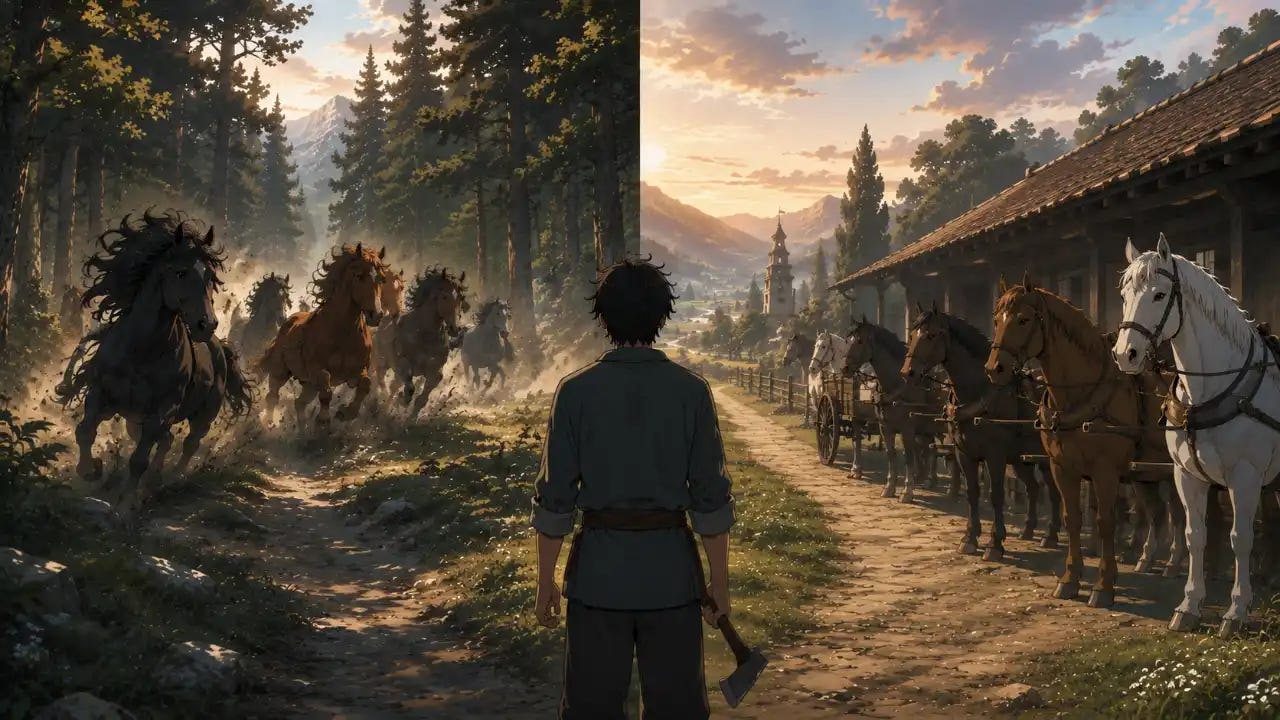
Standing right in front of the wood he had chopped, he savoured the echo of horses neighing.
A smile came to his wrinkled face, and in that moment, he knew what he had to do. The next morning, he did not hurry. He did not think about what he would do or how he would deliver the logs.
Instead, he chose to stay in bed for a long while, giving his body the rest it was asking for. And when he was fully content, he dressed himself in a nice suit and went to the stable.
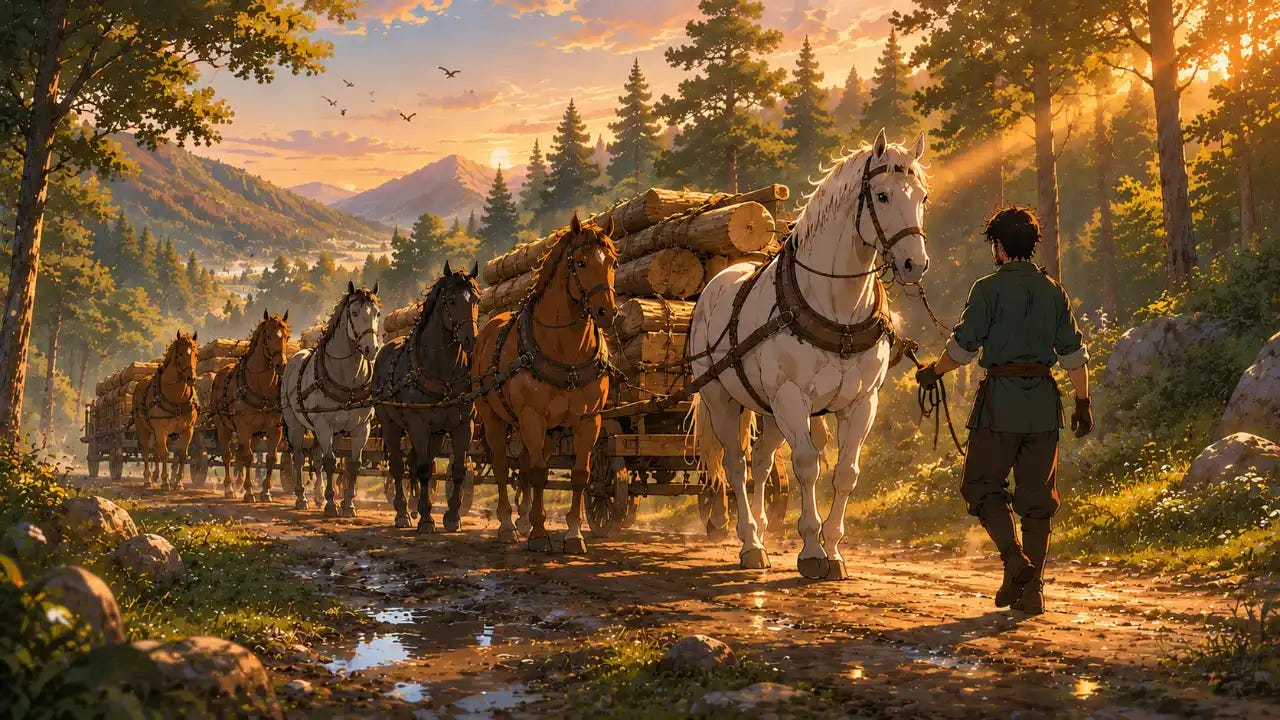
Yes, the stable. That same one he had crossed every day during his commute to the jungle. There, he rented six horses and three carts, and asked the stable owner to send a helper to assist him with the loading.
And with that, Mr. Whitwick was ready to deliver his first consignment.

The Views of Other Great People on the Earth
There were horses in the jungle, yet he chose the stable ones. The wild horses had mesmerised him the most, and yet he opened the doors of the stable. And not even one or two, he rented six horses to pull his carts and deliver the wood.
The wild horses were larger and faster, yet he chose something that had proven its strength within bounds.
And he had to pay nothing to own them. They were free and in abundance, yet he chose the ones that would stay with him only until the job was finished.
So why did he do that?
Why did he not trust the wild horses for the job and choose something else instead?
Why?
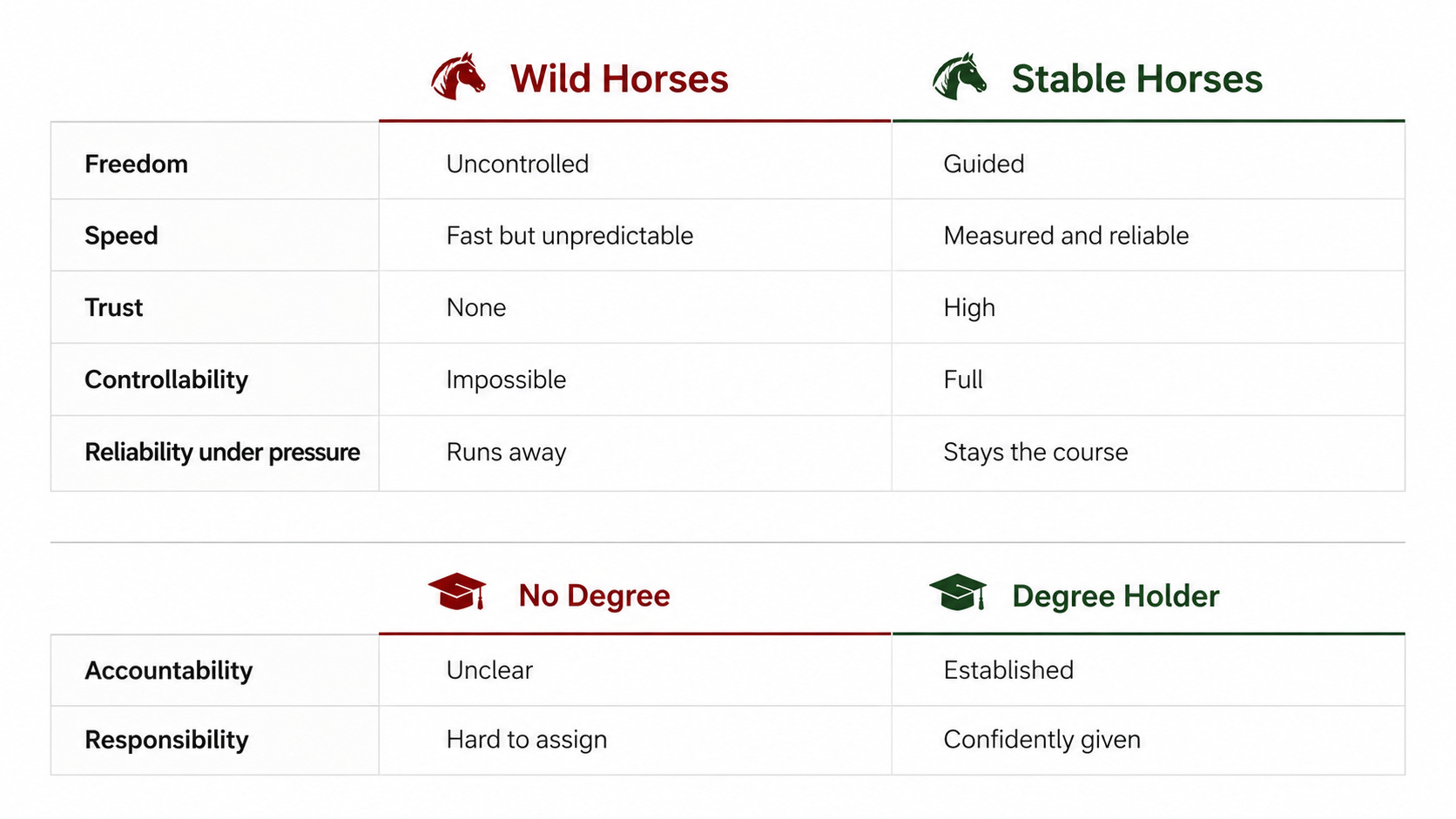
The answer is not hard. It is basic and simple: he had to finish his job. A job that requires full responsibility, and where there is responsibility, you need discipline. No responsibility can be fulfilled without proper discipline, and with wild horses, you cannot count on any.
So, he had to go with the stable ones. Because he could easily guide them, he could control them, and above all, trust that when the path grew challenging, they would not leave him and run away.
And through this metaphor, what I am trying to explain is this: in the era of AI, degrees will continue to matter.
You may hear many creators, such as DAN KOE and Scale AI founder Alexandr Wang, say that degrees will not matter, that a person with academic knowledge in a particular field will be made useless, or something to that effect, but that is only partially true.
Why?
I have just laid the whole idea in front of you.
Their thinking is based on their limited experiences. They have done multiple things in their domain, so they assume the same will hold in every area.
But organisations hiring people will continue to do so, and when they do, they will favour candidates with a degree, because it gives them the assurance that they can trust that person, give them responsibilities, and expect the discipline needed to fulfil their duties.
From a person who has nothing to lose, they cannot expect anything but friction.
Ask yourself, to build a bridge and ensure people’s safety, whom would you trust the most: the civil engineer with a degree and experience, or someone local with building experience?
I know what I would choose.
Many creators with large followings share the same ideology about degrees and education, and in my opinion, it is because they built their success entirely on their own. So they think the same will be true for everyone.
But let me give you another example of someone who changed our world, Steve Jobs.
He was a dropout, so the first clue we get is that “degrees don’t matter.”
But do you know what his last wish was when he was diagnosed with cancer? In the book The Ride of a Lifetime, Bob Iger shares that in one meeting, Steve mentioned that he wanted to see his son graduate from high school.
Graduate from high school.
A person who dropped out of school built a billion-dollar empire and wanted his child to graduate.
He could have wished for something else entirely, but he chose education because he knew it mattered, no matter how advanced the tools or technology we might have.
Yes, a leader can walk in the dark, but to determine whether the point they have reached is their destination, they need the light at the end of the tunnel, and that light is education.
To use those tools and that technology, you will need a hand, and that hand is your degree.
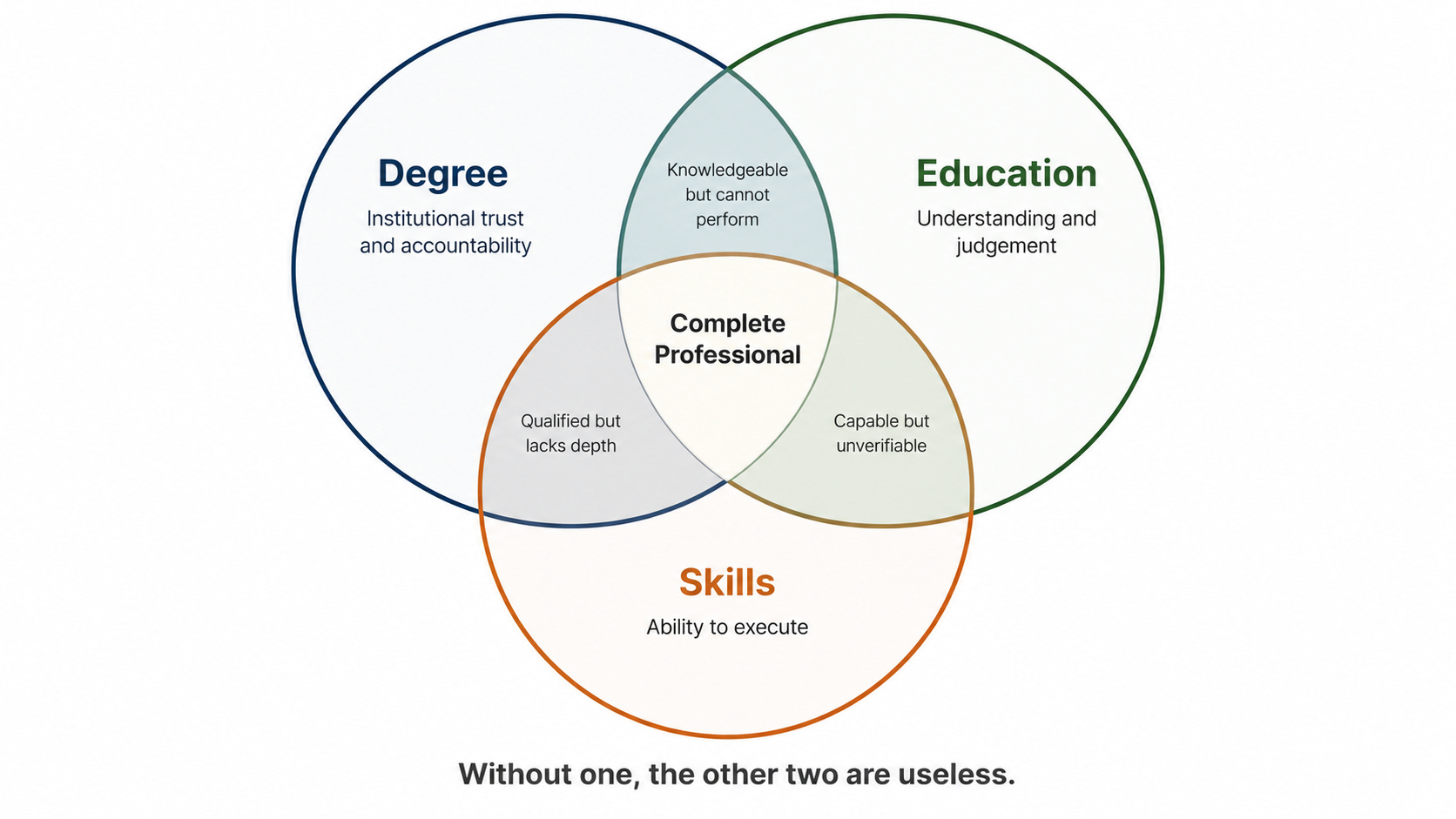
Now, do not confuse a degree with education, because they are not the same.

Degree, Education, and Skills Are Not the Same
Let’s start with skills.
You visit an online platform, and someone hacks your payment details and robs you.
That person has skills, but they do not possess education.
In a different scenario, someone enrols at a big university but never takes the lectures seriously. They somehow clear the course and get the degree, but when the time comes to perform, they lack both education and skills.
In a world where AI is making all the news, you need all three: Degree, Education, and Skills.
Without one, the other two are useless.
Just because a new invention in a particular field does everything humans used to do, it does not mean the rest of the things stop mattering. And it does not mean that because AI is working well in a field right now, degrees in that field no longer matter.
No, they do.
In more ways than one can imagine.
Because degrees are not just about giving you academics, they are also about helping you find like-minded people. They are about trusting a process, about exploring various things through your own eyes and the perspectives of others, too.
Because one person building the whole thing is not a genius in my view; he is just lonely, alone, and far more boring than Cillian Murphy.
He has no life.
And that kind of life does not matter, no matter what he builds.
The founders of these tools, like ChatGPT and Meta AI, do not let their children use these platforms. They are keeping them away and letting them learn through the conventional system.
So, how can we trust them when they say degrees do not matter?

Our Responsibility for Today and Tomorrow
Computers came to our world decades ago. They can calculate things faster than we, way faster, to be honest, and they can do a great many different things, but did that make us stop working on ourselves? Did we stop educating ourselves and creating a new generation of mathematicians?
Or did we simply incorporate them into our way of life to help us create things that once took much longer?
Ask yourself, does the degree of a medical student not matter?
Does the degree of a law student not matter?
They do, and likewise, many other degrees will continue to matter, whether we have AI or something better than it.
Our responsibility for the future should not be to disavow degree programmes; instead, it should be to ask how we can make those degree programmes better. We should work on the limitations and fill those gaps with or without the help of AI.
There is no doubt that AI is making us dumb, and we are letting it.
Instead of using it in ways that help us evolve, we are letting it downgrade the version of ourselves we have worked so hard to become.
And that is something we should not let happen. We should work on ourselves in a way that can challenge AI. The new, smarter competitor is AI, and it is a friend, too, but there is no use in a friendship we cannot match.
If not match, at least we should try, because in doing so, we will find ourselves in a far better place.
And we have to begin now, today, because tomorrow, it will be way ahead.
That is what this whole two-horse story was about.
I hope it made sense, and if you think it can help others, do not hesitate to share it with them.
Also, if you think ideas like this should not fade away, consider becoming a paid subscriber, because that is the only way to keep this space alive and honest. We need you.
Thank you.
Love,
Humble Human


The part that stayed with me most is this reminder that growth still asks something from us.
Tools may become smarter, faster, and more powerful; but discipline, awareness, responsibility, and inner growth still have to be cultivated within the human being.