
Keeping Promises
The promises we make throughout our lives.

I don’t know your age or where you are reading this from. You might be someone who is just beginning to explore the responsibilities of adulthood, or someone who has already lived through many seasons of life and is now reflecting more deeply on what truly matters.
Regardless of where you stand in your journey, there is something I am almost certain about. From your childhood until this very moment, you have made many promises.
Some of those promises were made to other people.
So, there were also promises you made quietly to yourself—commitments about waking up earlier, learning new things, improving your health, or becoming a better version of the person you were yesterday.
Some of those promises you were able to keep. Others slowly faded away with time, almost disappearing from your memory. And there are also promises that you could not keep.
That is part of being human.
None of us moves through life perfectly fulfilling every word we speak.
We make decisions with the understanding we have at the moment, and sometimes that understanding evolves. Recognizing this truth does not make us weak; it simply reminds us that we are living in a world where growth and imperfection often exist side by side.
Yet even though we are human and imperfect, there is still something about promises that deserves our attention.
A promise may appear to be just a few words spoken in a conversation or a thought that passes through our mind, but it carries more significance than we usually recognize.

A Promise Is More Than Words
When you make a promise, you are not simply telling another person that they can rely on you. At a deeper level, you are also communicating something important to your own mind.
Every promise becomes a message you send to yourself about who you are and how you intend to behave.
When you keep a promise, even a small one, your mind begins to register a pattern. It notices that your words are followed by action. Over time, this pattern builds a quiet but powerful belief inside you that you are someone who does what they say.
This belief may seem simple, but it forms the foundation of self-discipline and personal integrity.
Each fulfilled promise strengthens that foundation.
Your mind starts to recognize you as a reliable person, someone whose intentions carry weight. The more this pattern repeats, the stronger the connection becomes between your decisions and your actions.
Gradually, keeping promises stops feeling like a difficult effort and becomes a natural part of who you are.
However, the opposite pattern can also develop if promises are frequently broken.
How Broken Promises Shape the Mind
If your behavior consistently involves making promises that you do not keep, your mind slowly learns a different lesson.
At first, the difference may seem small and almost harmless. You might promise yourself that tomorrow you will wake up early, but when the alarm rings, you decide to sleep a little longer.
You may say that you will begin exercising, reading more, or focusing on an important task, but the day passes, and the intention never becomes action.
These moments appear ordinary, and most people dismiss them without much thought.
Yet the mind pays attention to every pattern we repeat.
Each time a promise is made but not fulfilled, the mind records a subtle signal suggesting that your words do not always translate into action.
Over time, this pattern begins to influence the way you see yourself. A quiet doubt appears whenever you make a new commitment. Your mind remembers the earlier experiences and begins to expect similar outcomes.
When you say you will do something tomorrow, part of you wonders whether it will actually happen.
This quiet loss of self-trust can make discipline feel much harder than it should be. The challenge is no longer just about waking up early or completing a task. The deeper challenge becomes convincing your own mind that your promises are meaningful.
The Mind Learns Through Repetition
Psychology often explains that the human brain learns through repetition and patterns.
Every action we perform reinforces certain neural pathways, making similar actions more likely in the future. When we repeatedly follow through on our intentions, the brain strengthens the pathways associated with discipline and reliability.
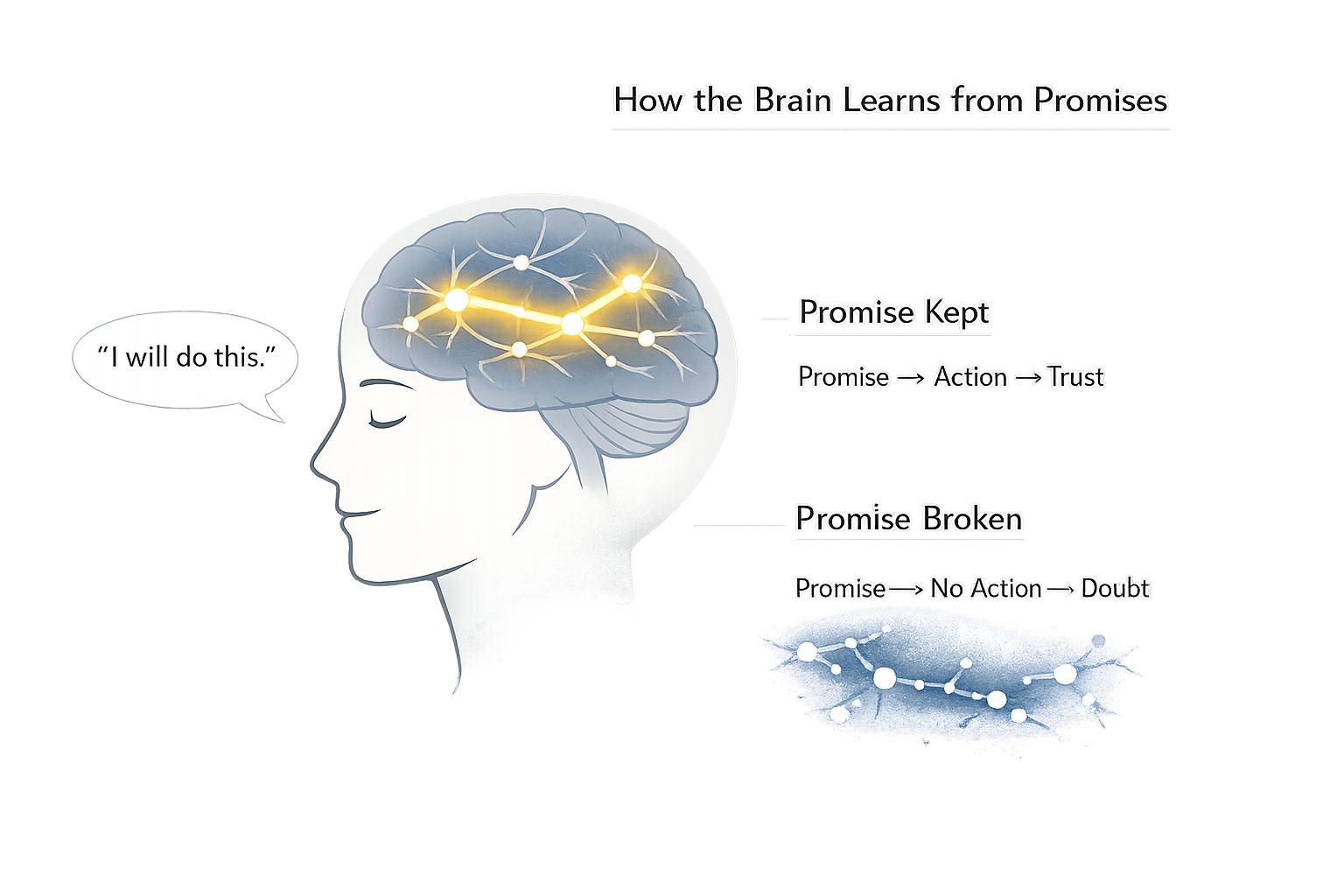
When we repeatedly postpone or abandon those intentions, the brain begins to expect hesitation and inconsistency.
Consider a simple example that many people experience.
At night, you decide to wake up early the next morning. In that moment, the decision feels sincere and reasonable. You set an alarm and go to sleep believing that you will follow through with the plan. When morning arrives and the alarm rings, however, the comfort of staying in bed feels stronger than the commitment you made the night before.
If this happens once, it may not have much impact. But if the pattern repeats frequently, your mind starts to interpret it as normal behavior. The next time you promise yourself you will wake up early, the internal expectation weakens because past experiences suggest the promise might not be fulfilled.
This process happens quietly, but it shapes how confident and disciplined we feel in our daily lives.
Why Early Guidance Matters
This principle is also visible in childhood development.
Children naturally experiment with truth and responsibility as they grow.
They sometimes lie or make promises they cannot keep because they are still learning how actions and consequences are connected. This is why guidance during childhood is important.
When adults patiently correct a child’s behavior and explain why honesty and responsibility matter, they are helping the child build healthy patterns.
The child begins to understand that words have meaning and that promises carry responsibility.
Over time, these lessons become part of the child’s character.
Without guidance, patterns of dishonesty or broken promises can become normal habits. Fortunately, even if those lessons were not learned perfectly in childhood, the human mind always retains the ability to learn new patterns.
At any stage of life, we can begin building habits that reflect greater honesty and discipline.
The Mistake of Too Many Promises
One common mistake people make when trying to improve their lives is attempting to change everything at once.
They create long lists of promises and resolutions: waking up early every day, exercising regularly, eating perfectly, reading several books each month, eliminating distractions, and becoming productive in every area of life.
While these intentions often come from a genuine desire for growth, they can easily become overwhelming.
Each promise adds another responsibility, and when too many promises exist simultaneously, the pressure becomes difficult to maintain. Eventually, one promise is broken, and once that happens, it becomes easier for the rest to collapse as well.
The result is frustration rather than progress.
The Power of Starting With One Promise
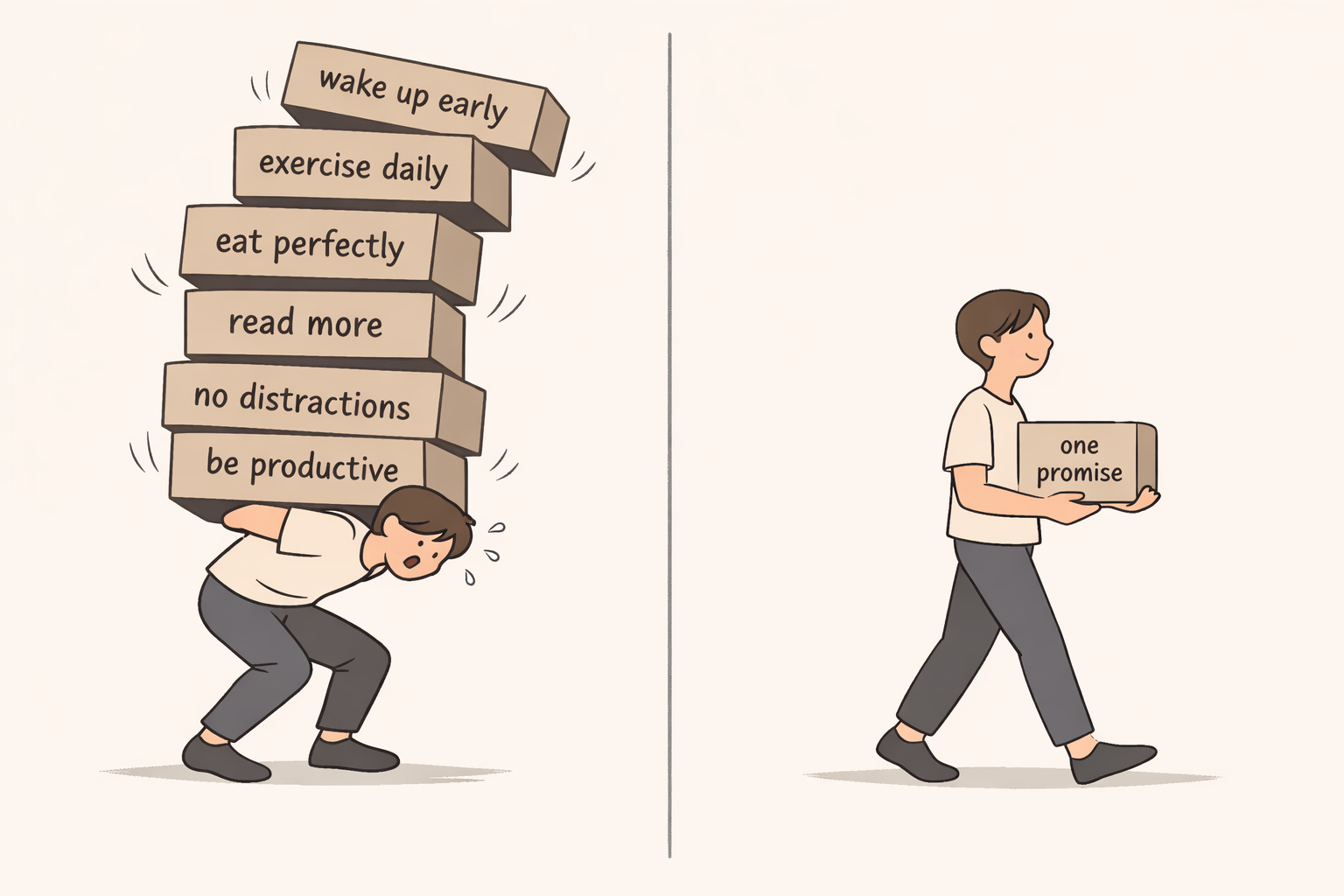
A more sustainable approach is far simpler.
Instead of making many promises, begin with one. Choose a commitment that is small enough to keep consistently without placing unnecessary pressure on your daily routine.
This promise does not need to be impressive. In fact, it is often better if it appears almost insignificant.
The purpose is not to create dramatic change immediately but to establish a pattern of reliability between your words and your actions.
You might promise yourself that you will drink one glass of water each morning after waking up.
Another person might decide not to drink coffee after a certain time in the afternoon. Someone else might commit to reading a single page of a book each day or taking a short evening walk.
These promises may appear too small to matter, but their true value lies in the consistency they create.
Building Self-Trust Through Small Actions
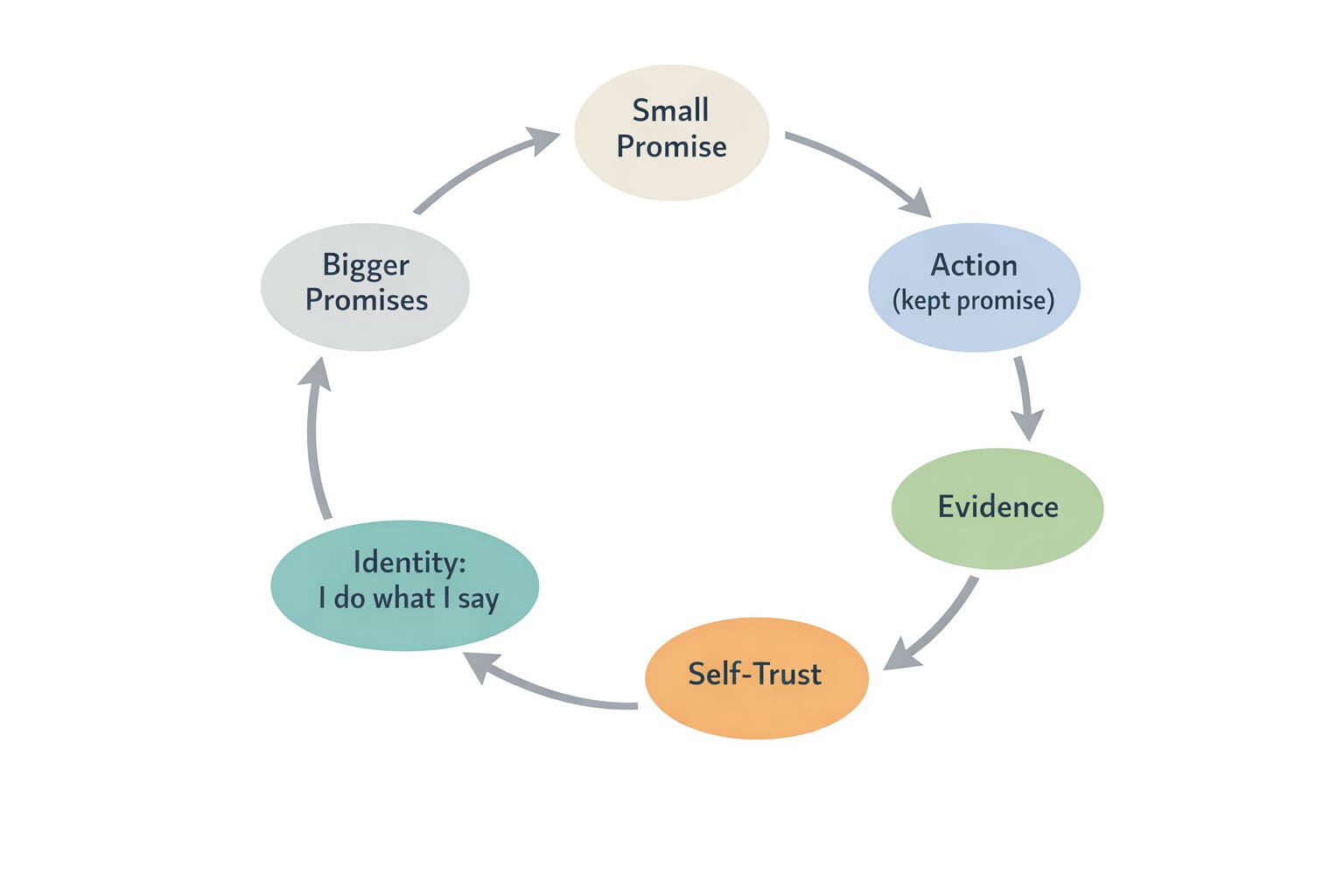
When you keep a small promise every day, your mind begins to experience a different pattern from the one it may have learned before.
It seems that when you say something, it actually happens.
This repeated experience slowly rebuilds self-trust.
As days turn into weeks and weeks turn into months, the promise becomes part of your identity. You start to see yourself as someone who honors commitments, even when those commitments are simple.
This quiet confidence gradually spreads into other parts of your life.
When you decide to pursue a larger goal, your mind already has evidence that you are capable of following through. This is how meaningful change usually develops—not through dramatic bursts of motivation, but through small actions repeated consistently over time.
The Quiet Growth That Follows
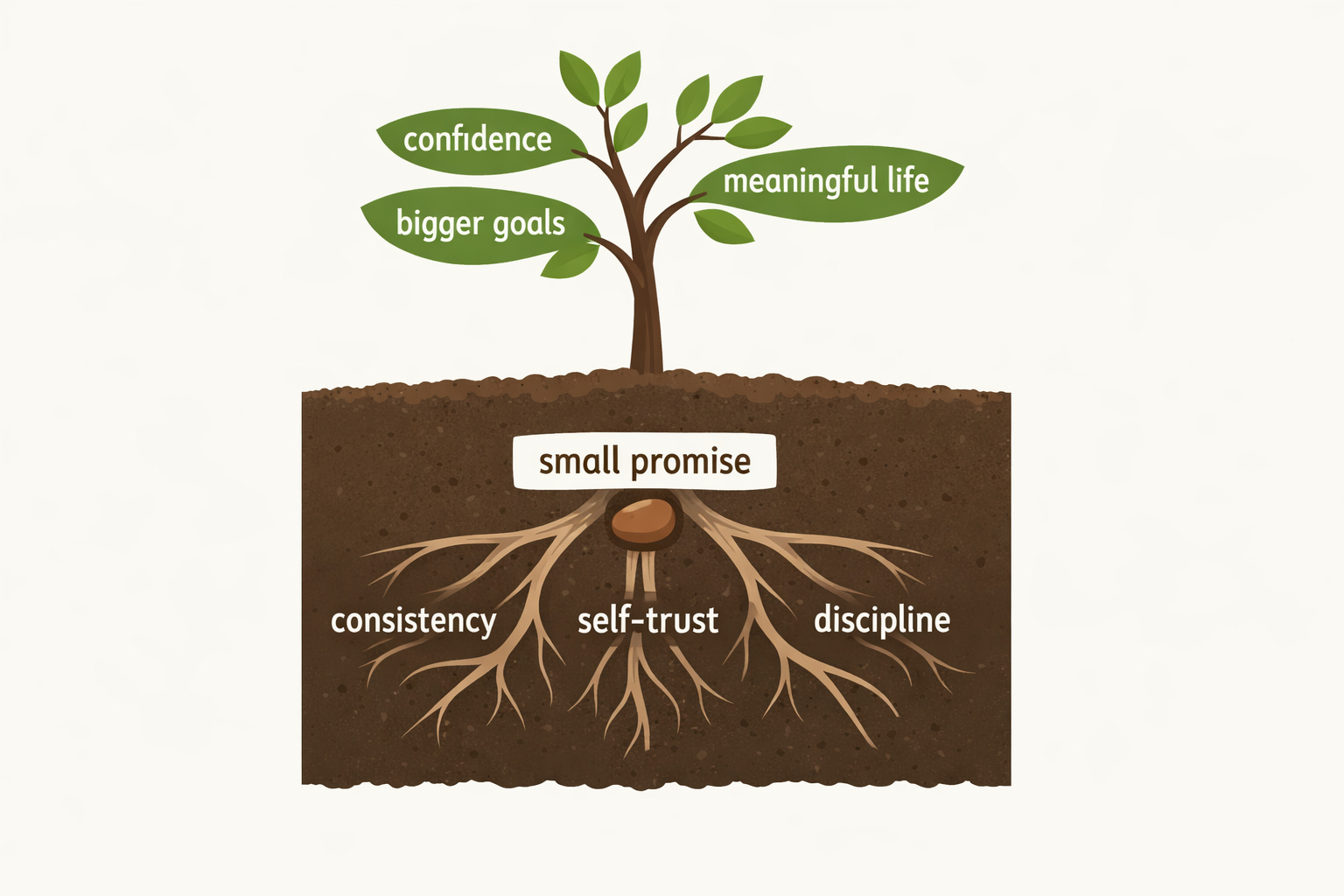
A single glass of water in the morning may eventually lead you to think more carefully about your health.
A few minutes of reading each day may awaken a deeper interest in learning.
A short walk might gradually encourage a more active lifestyle. None of these transformations happens immediately, but they grow naturally from the foundation of keeping promises.
More importantly, the relationship you develop with your own words becomes stronger.
When you know that your promises are reliable, your intentions carry more confidence and clarity. Your goals no longer feel like distant hopes but like commitments that guide your behavior.
A Gentle Invitation
If there is one idea worth carrying from this reflection, it is simply this: make a small promise and allow yourself to keep it.
Do not choose something that exists only to impress others or to prove your determination. Choose something personal, manageable, and honest.
Allow yourself to practice consistency without pressure or perfection.
Over time, you may discover that the feeling of fulfilling that promise is quietly meaningful. It is not the excitement of achieving a large milestone, but rather the calm satisfaction that comes from aligning your words with your actions.
Life will always remain unpredictable, and there will still be moments when promises cannot be kept despite our best intentions. Yet by treating our commitments with care and sincerity, we can slowly build a life in which our words carry weight, and our actions reflect the values we believe in.
Sometimes the most meaningful transformation begins with something very simple: doing what you said you would do.
Thank you for reading.
See you in my next post.
Till then, be a humble human.
This really resonated with me. I think the most painful part of broken promises is not the missed action itself, but the quiet loss of trust in ourselves. I appreciate that this piece brings the focus back to small, consistent actions instead of dramatic self-reinvention. It took me a long time to realize that small steps are not only easier to sustain, but often more life-changing than the fantasy of one decisive act that will transform everything at once.
went for evening walk today I was thinking about some things in my life why I don't believe in my abilities this article gave me clarification to some extent